Mathematics
Physics
© The scientific sentence. 2010
|
AMPERE'S LAW
1. Ampere's law
Let' see this figure:
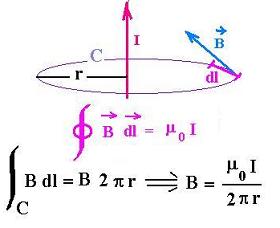
The circulation of the magnetic field a long the
contour C (along any closed path) is eaqual to μ0Ic.
Ic is the the current of conduction. It is
the net electric current crossing any surface bounded by the closed path C.
2. The differential form of the Ampere's law
The Ampere's law is derived from   the Biot-Savart's law :
 ∮ C B dl = μ0 I		(2)
It can be written as:
∮ C B dl = μ0 I = μ0 ∫∫S J dS		(3)
Using the Stoke's theorem, we get:
∮ C B dl = ∫∫S ∇  x B dS			(4)
(3) becomes:
μ0 ∫∫S J dS = ∫∫S ∇  x B dS		(5)
Then:
  ∇  x B = μ0J  			(6)
As ∀ V, ∇  . (∇  x V) = 0, then:
∇  . (∇  x B) = 0, and:
 Current conservation : ∇  . J = 0 			(7)
3. Maxwell's modifications
This equation is not complete. Maxwell added the fundamontal correction
to it. This modification can be understood by using the following approach.
The following figure shows what it could happen for a capacitor.
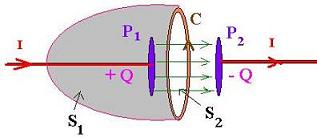
This capacitor contains two plate P1 and P2 with
two charges +Q and -Q respectively. The current of conduction goes
from P2 to P1 (in the figure, the direction of
this current is conventional).
The current must pierce the two surfaces because it links the
closed path C with is the bounadry if these surfaces. It musn't depend
on wich surface we select. It must be the same for any surface bounded by
the path. Forethermore there is an electric current between the plates.
It is calle the displacement current: Id.
If A is the surface of the plate, then we can write the magnitude of the
electric field as follows:
E = &sigma/ε0 = Q/ε0 A (according to Gass's law) (1)
sigma; is the surface charge density (= Q/A).
The the related flux is:
ΦE = E . A (2)
From (1) , we have :
Q = ε0 E.A = ε0 ΦE (3)
As I (equal to Id) = dQ/dt , then:
I = ε0 dΦE/dt (4)
3. New Ampere's law: The Ampere-Maxwell's law
The Ampere's law becomes then:
∮ B . dl = μ0 (Ic + Id)
Or:
∮ B dl = μ0 (I + ε0 ∂ΦE/∂t)
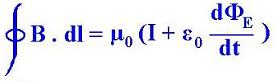
It can be written as:
∮ C B dl = μ0 (I + ε0 dΦE/dt) = μ0 ∫∫S J dS
According to the Stoke's theorem, and dΦE = E.S (dΦE/dt = (dE/dt) dS)
we get:
μ0 ∫∫S (J + ε0 dE/dt ) dS = ∫∫S ∇ x B dS
Then:
∇ x B = μ0 (J + ε0 ∂E/∂t)
Or:
∇ x B = μ0J + (1/c2)∂E/∂t
Write again:
∇ . (∇ x B) = 0, that is:
∇ . (μ0J + (1/c2)∂E/∂t) = 0
Hence:
∇ . J + ε0 ∂(∇ .E)/∂t = 0
According to Gass's law , which is :
∇ . E = ρ/ε0
We have then:
Current-Charge conservation : ∇ .J + ∂ρ/∂t = 0
|
|