Mathematics
Physics
© The scientific sentence. 2010
|
BIOT-SAVART'S LAW
1. Different expressions of the Biot-Savart's law
The Biot-Savart law gives the expression of the magnetic
field due to a moving charge.
If a charge Q is moving, the related current is I = dQ/dt.
The expression of the Biot-Savart law is:

Remark that r is the distance from the origin to
the point where the measure is done. the element
of wire dl ( the source) is at the origin as well.
Application:
If R is fixed as the radius of the circle,We can theb write:
dB = (μ0/4π) I (dl x r) /r2
B = ∫ dr (μ0/4π) I (dl) /r2
= (μ0/4π) I (dl) ∫ dr /r2
(from - ∞ t + ∞)
= (μ0/4π) I (dl) (-1/r)
(from - ∞ to R + from R to + ∞)
= 2/R
B = (μ0/4π) I (dl) (2/R)
Thus:
∮ B = (μ0/4π) I (2π R) (2/R) = μ0I
∮ B = μ0I
That is the Ampere's law.
when the source dl is not at the origin ( at r' from
the origin) then the point of the mesearement is at r - r'.
The Biot-Savart takes the following form:


From the realtionship:
dI = J . dS
that espresses I as the flux of the current density J through
the surface elemnt dS, we can write:
I dl = J . ds . dl
dS . dl = volume unit = d3r'
It follows that :
J . ds . dl = J(r') d3r'
The Biot-Savart law becomes:

Not the the current density is located at the source
position r' and the magnetic field B is measered at the
poit r from the origin.
2. Examples
2.1. Example 1 : Straight infinite wire

An electric current I is carried by an infinite
straight wire of element dl
The expression of the magnetic field B at the distance r
is given by the Biot-Savart's formula:

The expression of the magnetic field B at the distance r
is given by the Biot-Savart's formula:
(For more details about the relatedd integrale,
refer to Related integrale
2.2. Example 2 : Loop
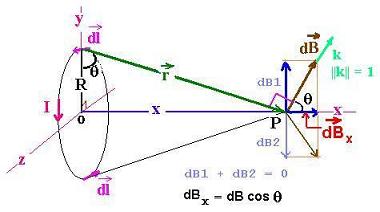
We have:
dBx = dB cos θ
dB = (μ0/4π) I dlx r /r2
= (μ0/4π) I dl k /(x2 + R2)2
Then:
dBx =(μ0/4π) I dl cos θ /(x2 + R2)2
=(μ0/4π) I dl R /(x2 + R2)3/2
It follows that:
B = (μ0/4π) I R /(x2 + R2)3/2 ∫ dl
∫ dl = 2πR, hence:
B = (μ0 I R2/2) /(x2 + R2)3/2
Or:

2.3. Example 3 : The expression of the vector potential A
Let the following figure:

P = P (x,y,z) is the observation point.
P' = P'(x', y', z') is the measurement point.
R = r - r'
We have :
B = (μ0/4π) ∫ I (dl) x ( r - r') / |r - r'|3 =
(μ0/4π) ∫ I (dl) x R/R3
We know from the gradient operator
that: ∇ (1/R) = - R/ R3
Then:
B = (μ0/4π) ∫ I (dl) x (- ∇ (1/R))
We know also from the Curl operator that:
∇ x (φ J) = φ ∇ x J + (∇ φ) x J
With: (∇ φ) x J = - J x (∇ φ)
Then:
J x (∇ φ) = φ ∇ x J - ∇ x (φ J)
It follows that:
dl x ∇ (1/R) = (1/R); ∇ x (dl) - ∇ x ((1/R) dl)
The operator ∇ operates with respect to (x, y, z), but
dl is a function of (x', y', z') then: ∇ x (dl) = 0
Thus:
dl x ∇ (1/R) = - ∇ x (dl/R)
We have then:
B = (μ0/4π) ∫ I ∇ x (dl/R) = ∇ x (μ0/4π) ∫ I(dl/R)
Since : B = ∇ x A
Then:
A = (μ0/4π) ∫ I(dl/R)
I is the electric current
dl is the displacement elemnt.
2.4. Example 4: Long wire and rectangular current loop
Let the following figure:
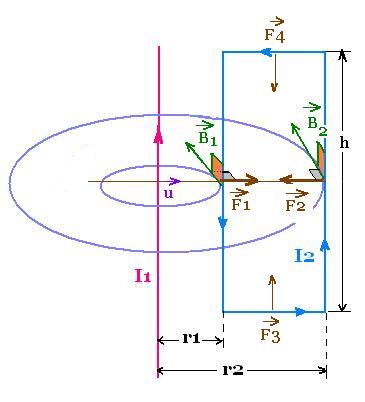 The magnitude of the magnetic field from the wire carrying
an electric current I1, at the distance r1 is:
B1 = μ0 I1/2π r1.
At the distance r2:
B2 = μ0 I1/2π r2
The Lorentz forces over the top and the bottom (F3 and F4) of the frame cancel
(because the two forces have the same magnitude and opposite
direction). The two opposite forces at the distance r1 is:
F1 = B1 I2 h, and at the distance r2 is F2 = B2 I2 h. These
two forces are along an opposite direction, we have then:
F = F1 - F2 = B1 I2 h - B2 I2 h = I2 h (B1 - B2) =
I2 h (μ0 I1/2π r1. - μ0 I1/2π r2) =
I2 h μ0 I1/2π (1/r1. - 1/ r2)
F = F1 - F2 = I2 h μ0 I1/2π (1/r1. - 1/ r2)
F = F1 - F2 = μ0 I1 I2 h /2π (1/r1 - 1/ r2)
μ0 = 4π x 10-7 T m/A (Tesla meter/Ampere). So
F = F1 - F2 = 2 x 10⁻⁷ I1 I2 h / (1/r1 - 1/ r2)
The force, here, is rightwords.
Example:
I1 = 2 Amperes, I2 = 3 Amperes, h = 30 cm, r1 = 10 cm, r2 = 20 cm.
F = 2 x 10-37 2 x 3 x 30 / (1/10 - 1/ 20) = 18 x 10-7 Newtons.
Checking units:
1 Tesla = 1 kg A-1s-2
F = T m A-1 A A = kg A-1s-2 m A-1 A A
= kg m s-2 = N (Newtons)
© The ScientificSentence. 2007.
|
|