Mathematics
Physics
© The scientific sentence. 2010
|
DIVERGENCE OPERATOR
I. Definitions
I.1. Operator part: ∂
	We define the vector partial: ∂ as follows:
	∂ =  ( ∂/∂x, ∂/∂y, ∂/∂z) = (∂x, ∂y, ∂z)
I.2. Divergence
	We define the  Divergence  of a vector R = (Rx, Ry, Rz) as
	follows:
	Div (R) = ∇(R) = ∂Rx/∂x + ∂Ry/∂y + ∂Rz/∂z = ∂ . R
	(dot product: Partial . Vector).
	The result is a scalar.
II. Applications
II.1. Relationship between divergence and flux
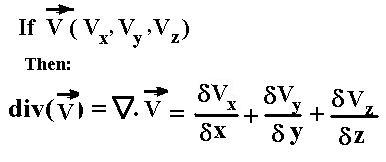
We want to demonstrate that the divergence of a vector (for instance
the electric field E) is equal to the rate of the related flux and
the related volume.
We can write:
div(E) = dEx/dx + dEy/dy + dEy/dz
dV . div(E) = dx.dy.dz.div(E) =
dExdy.dz + dEydx.dz + dEydx.dy
= flux of Ex through dy.dz element + flux of Ey through dx.dz element
+ flux of Ez through dx.dy element =
flux of dE through the wrapping surface
(as in a box).
Then:
	dV.div(E) = dV. ∇. E = dS.dE
	Hence:
	 div(E)  = ∇. E = flux/ volume
|
|