Mathematics
Physics
© The scientific sentence. 2010
|
GAUSS'S THEOREM
1. Gauss's theorem
Gauss's theorem is also called Divergence theorem.
We will demonstrate it here.
Let's look at this figure. We consider that the box is small. So dx, dy and dz are
small as well.
The net flux of the vector A at x is A(x) dy dz.
At x + dx, it's equal to A(x + dx) dy dz.
The variation of the vector A through the box from the
surface (dy,dz) at x to the same surface at x+dx is:
Ax(x+dx) - Ax(x) = (∂Ax(x)/∂x) dx
Then the related net flux is:
(∂Ax(x)/∂x) dx dy dz = (∂Ax(x)/∂x) dV
Where dV = dx dy dz , the elementary volume.
With the same approach, we have :
Through the y axis:
(∂Ay(y)/∂y) dy dx dz = (∂Ay(y)/∂y) dV
Through the z axis:
(∂Az(z)/∂z) dz dx dy = (∂Az(z)/∂z) dV
The total flux out of the infinitesimal box is then:
dΦA = (∂Ax(x)/∂x + ∂Ay(x)/∂y + ∂Az(z)/∂z))dV
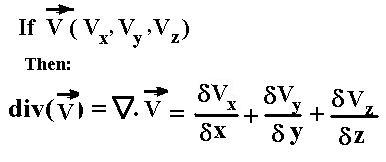
The term ∂Ax(x)/∂x + ∂Ay(x)/∂y + ∂Az(z)/∂z is the
divergence of the vector A, that is ∇ . A.
So dΦA = ∇ . A dv
Hence :
ΦA = ∫Volume: V dΦ = ∫V ∇ . A .dV
We know also that:
ΦA = ∫S A . dS
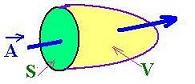
Where S is the surface that bounds the volume V
Therefore, we get:
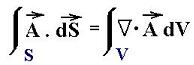 
That is Gauss's theorem.
2. Particular case: The Electric field vector
In this case, we have:
∫∫S E dS = Q/ε0 (E-Gauss's law)
That is:
∫∫∫V(∇.E)dV = ρ/ε0∫∫∫V dV
Thus:
∇.E = ρ/ε0
3. Other result : The curl Theorem
If A = (Ax, Ay, Az)
and dv = dxdydz a volume element, then:
∫ ∇ x A dv = ∫[(∂Ay/∂z - ∂Az/∂y)dxdydz,
(∂Az/∂x - ∂Ax/∂z)dxdydz, (∂Ax/∂y - ∂Ay/∂x)dxdydz]
= ∫ [Aydxdy - Azdxdz, Azdydz - Axdxdy, Axdxdz - Aydydz]
= ∫ A x dS
with dS = (dydz, dxdz, dxdy) = ds. n
where n is the vector normal to the related surface. dydz, dxdz, dxdy are
the faces perpendicular to their related normal vector.
Hence:
∫ ∇ x A dV = ∫ A x dS = ∫ A x n ds
|
|