Mathematics
Physics
© The scientific sentence. 2010
|
LIENARD-WIECHERT POTENTIALS
I. Distortion of the volume
Let's see this figure:

Let's consider that the cube moves toward the observer.
If the cube moves at the velocity V, then It will make
Vt to reach the same position as a photon traveling at the
speed of light c. we suppose that the cube and the photon
leave the origin at x = 0 and t = 0.
The photon will moves ct = Vt + a to reach the face at right.
a is the length of the cube.
We can write then:
t = a/c - v. (1)
The measure of the length of the cube over x by the observer will
give:
Apparent length = ct = ca/c - v = a/(1 - v/c). (2)
To recap, we say:
The other sides ( over y and z) are not atffected by the distotion.
The measure of the side over x gives an apparent length ( which is
contracted) increased by the factor 1/(1-v/c).
It follows that any side considered could be projected over
some axis in order to keep only the component directed
toward the observer wich is the only direction that is related
to the distortion.
Foe example, in any direction that the charge moves, only
the distortion over (r - r') is considered. There after, we can
write the volume related to the density of charge as follows:
Apparent volume = distorded volume = true volume /(1 - v/c)
The element : dr'3 / r - r' is distorded only when
the density of charges moves toward the observer; that is
the vector velocity V of the density of charge is parallel to
the vector r - r'. That is :
Apparent volume = True volume / ( 1- û . V /c ) (3)
û is the vector unit of the vector ( r - r').
II. New expressions for the potentials
Recall from  the expressions of the potentials φ and A  we have:
1. For Statics:
Φ = (1/4πε0)  ∫ ρ(r')d3r'/|r -r'|		(4)
A(r) =  μ0/4π∫ J(r') /|r-r'| d3(r')		(5)
2. For Dynamics:
Φ(r) = (1/4πε0)  ∫ d3r' ρ(r', tr)/|r - r'|		(6)
A(r) =  μ0/4π∫ d3r' J(r', tr) /|r-r'| .		(6)

Taking account of the distortion, (statics remains statics, V = 0
and foretheremore the expressions of φ(r) and A(r) remains
as they were). The expressions for the dynamic case become:
Φ(r) = (1/4πε0)  ∫ d3r' ρ(r', tr)/( 1- û . V /c )|r - r'|		(7)
A(r) =  μ0/4π∫ d3r' J(r', tr) /( 1- û . V /c )|r-r'| 		(8)
III. Retarded Potentials
We know from  The Green's function that the equation of the form:
Δ ψ(r) = U(r) ψ(r)
Has to satisfy the Green's function:
ΔG(r) = δ(r - r'); which has the solution:
G(r)= (-1/4π) . 1/(r - r')
to give the sulution:
ψ(r) = ∫ G(r - r') U(r') d3r' 	(9)
Hence:
ψ(r) = (-1/4π) ∫ U(r')/ (r -r') d3r' 		(10)
For the sources:
U(r') = ρ(r', t'), we have :
ψ(r) = (-1/4π) ∫ ρ(r', t')/ (r -r') d3r'		(11)
U(r') = J(r', t'), we have :
ψ(r) = (-1/4π) ∫ J(r', t')/ (r -r') d3r'		(12)

We know from  The potentials  that with the Lorentz gauge; the equations:

☐2 φ = - ρ/ε0
☐2 A = - μ0J
With ☐2 = Δ A - (1/c2)d2/dt2
have the retarded solutions:
Φ(r) = (1/4πε0)  ∫ d3r' ρ(r', t')/|r - r'|
A(r) =  μ0/4π∫ d3r' J(r', t') /|r-r'|
with: t - t' = |r - r'|/c; t' is the retarded time.
These solutions are complete with the expression given by Lienard and Wiechert.
In fact, the solution of the equation:
☐2 ψ(r',t') = S(r',t') has the folowing Green function:
G(r,t,r',t') which satisfay :
(Δ - (1/c2)d2/dt2)G(r,t,r',t') = δ(r - r')δ(t - t').
With G(r,t,r',t') = δ( t' - (t-|r - r'|/c)).
The retarded potentials become then:
Φ(r) =
(1/4πε0)  ∫ δ( t' - (t-|r - r'|/c))d3r' dt' ρ(r', t')/|r - r'|   (13)
A(r) =
μ0/4π∫ δ( t' - (t-|r - r'|/c)) d3r' dt' J(r', t') /|r-r'| 	(14)
IV. Potentials of a moving charge
Now, let's see this figure related to a moving single charge:
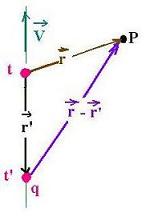 We want to express the potentials φ and A from
the point P. At this point, we know nothing about the
charge at the time t, just it is at the position r',
and the distance r - r'.
While the charge was moving
from t to t' with a volocity V ( then |r'| = V(t - t')),
the potentials were traveling with the spped of light c
to reach the point P; then |r - r'| = c( t - t'); hence:
t - t' = |r'|/V = | r - r'|/c. Not that: V = dr'/dt'
Quickly, we can write:
∫ρ(r')d3(r')/| r - r'| = q/| r - r'| for a single charge.
Here, we use Dirac's delta function :
q. δ ( r' - r'(t')) for &phi(r'), and
qV.δ ( r' - r'(t')) for J(r').
Now, let's using Dirac's delta function related to the space:

Φ(r,t) = (1/4πε0)  ∫ δ( t' - (t-|r - r'|/c)) d3
r' dt' q. δ ( r' - r'(t')) /|r - r'|
A(r,t) =  (μ0/4π) ∫ δ( t' - (t-|r - r'|/c)) d3r' dt' qV.
δ ( r' - r'(t'))  /|r-r'|

Using the proporty of the delta function:
∫ f(x) δ( x- x0) dx = f(x - x0); it folows that:

Φ(r,t) = (1/4πε0)  ∫ q δ( t' - (t-|r - r'|/c)) dt'  /|r - r'(t')|
A(r,t) =  (μ0/4π) ∫qV  δ( t' - (t-|r - r'|/c)) dt' /|r-r'(t')|

Here, we cannot use immediatly the Dirac's function because the term r'
is present in the delta function. Let's do this transformation:
τ = t' - (t-|r - r'|/c) ; then dτ = dt' + ((1/c)dR(t')/dt')dt' or dτ = dt'(1 + ((1/c)dR/dt'))
with |r - r'| = R(t')
hence: dt' = dτ/ (1 + ((1/c)dR/dt'))		(15)

the potentials becomes:
Φ(r,t) = (1/4πε0)  ∫ q δ(τ) dτ/
((1/c)dR(t')/dt')  /R(t')		(16)
A(r,t) =  (μ0/4π) ∫qV  δ(τ) dτ/
(1 + (1/c)dR(t')/dt') /R(t') 		(17)
Now, we can use the above property of Dirac's delta function.
The non-zero value is obtained for τ = 0, hence:

Φ(r,t) = (1/4πε0) q / ( 1+ (1/c)dR(t')/dt') /R(t')		(18)
A(r,t) =  (μ0/4π) qV / ( 1+ (1/c)dR(t')/dt') /R(t')		(19)
Rearranging, we find:

 Φ(r,t) = (q/4πε0) / R(t') (1 + (1/c)dR(t')/dt') 		(20)
 A(r,t) =  (qV μ0/4π) /R(t') (1 + (1/c)dR(t')/dt')   		(21)

We want to give an explicit expression for : R(t') (1 + (1/c)dR(t')/dt').

We have:
dR(t') / dt'= d| r - r(t')|/dt' =
(d/dt') ( (x - x') + ( y - y') + ( z - z') )  1/2
= (1/2) ( (x - x') + ( y - y') + ( z - z') )  -1/2 ( 2( x - x') (-dx'/dt') + 2( y - y') (-dy'/dt')
+ 2( z - z') (-dz'/dt') = (1/2) 2 (r - r') . ( - dr'/dt) / | r - r'| =
(r - r') . ( - dr'/dt) / | r - r'| = - V .(r - r') / | r - r'|

It follows that:
R(t') (1 + (1/c)dR(t')/dt') = R(t')  + (1/c) R(t')dR(t')/dt'= |r - r'|  - (V/c) . (r -r')


Finaly, the potentials can be written as:
 Φ(r,t) = (q/4πε0) / |r - r'|  - (V/c) . (r - r')  		(22)
 A(r,t) =  (qV μ0/4π) /|r - r'|  - (V/c) . (r - r')    		(23)
 at the time t' = t - |r - r'|/c .
These potentials are function of r and t; at the time t' = t - |r - r'|/c
These are the  Lienard-Wiechert potentials.

Let's remark that :
A(r,t) = V μ0ε0φ(r,t) = (V/C2)φ(r,t).		(24)
V. Expressions of E and B
Fromthe expressions of φ and A, we will find the ones of E and
B, using the following:
E = - ∇φ - dA/dt
B = ∇ x A
We have :
Φ(r,t) = (q/4πε0) / |r - r'| - (V/c) . (r - r')
A(r,t) = (qV μ0/4π) /|r - r'| - (V/c) . (r - r')
= V μ0ε0φ(r,t) = (V/C2)φ(r,t)
t' = t - |r - r'|/c
We will use the notation: R = r - r'
And:
∂i = ∂ / ∂xi
∂i = ∂ / ∂xi = (∂/∂t') (∂t' / ∂xi)
V.1. Expression of ∇φ
We will start by the first term in the above expression of E.
∇φ = ∇(r,t) = q/4πε0. ∇(1 / (|R| - (1/c) (V) . (R)))
∇(1 / (|R| - (V/c) . (R))) = - 1 (∂i)[|R| - (V/c) . (R)] /[|R| - (1/c) (V) . (R)]2
The task is to evaluate: ∂i[|R| - (1/c) (V) . (R)].
∂i[|R| - (1/c) (V) . (R)] = ∂i|R| - (1/c) (R) . ∂i(V) - (1/c) (V) ∂i(R).
Let: Terms = (First term) - (1/c) [(Second term term) + (Third term)]
∇φ will be: ∇φ = ∇(r,t) = - q/4πε0. (Terms) /[|R| - (V/c) . (R))2]
The advantage to use the tensors, here, is to derive the first component
of thevector; the two other components will have the same results
by changing x into y and z.
From the tensor notation (II.2.7) we can write:
First term:
First term = ∂i)|R| = ∂|R|/&partxi = ∂|R|/∂t') (∂t' / ∂xi = ∂c(t - t')/∂t') (∂t' / ∂xi
∂|R|/∂t')= (-c) (∂t' / ∂xi
Second term:
Second term = (R) . ∂i(V) = (R) . ∂i(V) = ∂i (V) = (∂ (V) /∂t') (∂t' / ∂xi)
(∂ (V) /∂t') = a ; that is the acceleration of the charge particle moving
at the volocity V at the position r'(t').
(R)∂i (V) = (R) a (∂t' / ∂xi)
Third term:
Third term = (V). ∂i(R)
∂i(R) = ∂(R) / ∂xi = ∂(r) / ∂xi - ∂( r') / ∂xi
We have: R = xi - xi'
∂(r) / ∂xi - ∂( r') / ∂xi = ∂(xi) / ∂xi - ∂x'i / ∂xi
∂(xi) / ∂xi = δij
∂x'i / ∂xi = (∂x'i / ∂t') (∂t' / ∂xi) =
(V) (∂t' / ∂xi)
Then:
Third term = (V). (δij - (V) (∂t'/ ∂xi)) =
Vi - Vi V (∂t'/ ∂xi) = V - VVi(∂t'/ ∂xi)=
V - V2(∂t'/ ∂xi)
(V). ∂i(R) = V - V2(∂t'/ ∂xi)
It remains to calculate: ∂t'/ ∂xi
∂t'/ ∂xi = ∂( t- |R|/c)/ ∂xi
We have : ∂t/∂x = 0
Then: ∂( t- |R|/c)/ ∂xi = (- 1/c) ∂(|R|)/ ∂xi
∂(|R|)/ ∂xi = ∂(Σ(xi - x'i)2)1/2/ ∂xi =
(1/2)(1/|R|) (2) (R) ( δij - ∂x'i/ ∂xi) =
(1/|R|) ( (R) δij - (R) ∂x'i/ ∂xi) =
(1/|R|) ((R) - (R)∂x'i/ ∂t') (∂t'/ ∂xi) =
(1/|R|) ( (R) - (R).(V) (∂t'/ ∂xi)
Hence:
∂t'/ ∂xi = ( -1/c)(1/|R|) [(R) - (R). (V) (∂t'/ ∂xi)]
Solving for ∂t'/ ∂xi, it follows that:
∂t'/ ∂xi[1 - (1/c)(1/|R|) (R).(V)] = ( - 1/c)(1/|R|) (R)
Then:
∂t'/ ∂xi = ( - 1/c)(1/|R|) (R)/ [1 - (1/c)(1/|R|) (R).(V)]= - (R)/(c|R| - (R) .V )
∂t'/ ∂xi = - (R)/(c|R| - (R) . V )
Rearranging, we find:
Terms = (First term) - (1/c) [(Second term term) + (Third term))] =
(- c) (∂t' / ∂xi - (1/c) [((R) . a (∂t' / ∂xi) ) + (V - V2(∂t'/ ∂xi))] =
(∂t' / ∂xi)[ - c - (1/c) ((R) . a) + (1/c) V2 ] - V/c
= [- (R)/(c|R| - (R) .V )][ - c - (1/c) ((R) . a) + (1/c) V2] - V/c
Then:
∇φ = ∇(r,t) = - q/4πε0. (Terms) /(|R| + (V/c) . (R))2
= - qc2/4πε0. (Terms) /(c|R| - V . (R))2
= - (qc/4πε0)[- (R)/(c|R| - (R) .V ))( - c2 - (R) . a + V2) - V]/[c|R| - V . (R)]2
∇φ = (qc/4πε0)/(c|R| -
V . (R))3[(-R)( c2 + (R) . a - V2 ) + V(c|R| - V . (R))]
More clearly,

V.2. Expression of ∂A/∂t
We have A = (V/c2)φ
∂A/∂t = ( ∂A/&pat;t')( ∂t'/∂t)
= (∂(V /c2φ)/∂t') ( ∂t'/∂t)
= φ∂(V/c2)/∂t' + (V/c2)(∂φ/∂t') ( ∂t'/∂t)
= φ(a/c2) + (V/c2)(∂φ/∂t') ( ∂t'/∂t)
∂φ/∂t'= ∂[(qc/4πε0)(1/(c|R| - (R) .V))]/∂t'
= (qc/4πε0) ∂[(1/(c|R| - (R) .V)]/∂t'
= (qc/4πε0) (- 1/(c|R| - (R) .V)2) ∂/∂t'[(c|R| - (R) .V)]
∂/∂t'[(c|R| - (R) . V)] = c ∂/∂t'(|R|) - ∂/∂t'[(R) .V ]
= c ∂/∂t'(R|) - V. ∂/∂t'[(R) ] - (R). ∂/∂t'(V)
First term:
∂/∂t'(|R|) = ∂/∂t'(c( t - t') = c ( ∂t/∂t'- 1)
Second term:
V. ∂/∂t'[(R)] = V . ( - V) = - V2
Third term:
(R). ∂/∂t'(V) = (R).a
Then:
∂/∂t'[(c|R| - (R) . V)] = c2( ∂t/∂t'- 1) + V2 - (R).a
= c2( ∂t/∂t') - c2 + V2 - (R).a
It follows that:
∂φ/∂t'= (qc/4πε0) (- 1/(c|R| - (R) . V)2)
[c2( ∂t/∂t') - c2 + V2 - (R).a]
= φ (- 1/(c|R| - (R) . V)) [c2( ∂t/∂t') - c2 + V2 - (R).a]
And :
∂A/∂t = [ φ a/c2) + (V/c2)(∂φ/∂t') [( ∂t'/∂t)]
= ∂A/∂t = [φ a/c2) + (V/c2)(φ (- 1/(c|R| - (R) . V)) [c2( ∂t/∂t') -
c2 + V2 - (R).a]) ][( ∂t'/∂t)]
= φ [a/c2) + (V/c2)[(1/(c|R| - (R) . V)) (- c2( ∂t/∂t') +
c2 - V2 +(R).a) ][( ∂t'/∂t)]
= [φ/c2/(c|R| - (R) . V))] [a(c|R| - (R) . V)) - Vc2(∂t/∂t') +
V(c2 - V2 +(R).a))][(∂t'/∂t)]
=[φ/c2/(c|R| - (R) . V))] [[a(c|R| - (R) . V)) + V(c2 - V2 +
(R).a))][(∂t'/∂t)] - Vc2]
= - Vφ/(c|R| - (R) . V) + [φ/c2/(c|R| - (R) . V))] [[a(c|R| - (R) . V)) +
V(c2 - V2 +(R).a))][(∂t'/∂t)]
Now, let's express the term: ∂t'/∂t
t' = t -|R|/c
∂t'/∂t = 1 - (1/c) ∂|R|/∂t
∂|R|/∂t = ∂[Σ ( xi - x'i)2]1/2 /∂t
= (1/2) (2/|R|) R (- V ∂t'/∂t) = - R V ∂t'/∂t)/|R|
Solving for ∂t'/∂t, it follows:
∂t'/∂t = 1 - (1/c)(- R V ∂t'/∂t)/|R|) = 1 + (R V ∂t'/∂t)/c|R|
∂t'/∂t = 1 / [ 1 - R.V/c|R|] = c|R|/(c|R| - R.V)
Then:
∂A/∂t = - Vφ/(c|R| - (R) . V) + [φ/c2/(c|R| - (R) . V)) ] [[a(c|R| - (R) . V)) +
V(c2 - V2 +(R).a))][(∂t'/∂t)]
= - Vφ/(c|R| - (R) . V) + (φ/c2/(c|R| - (R) . V)) [[a c|R| + Vc|R|(c2 - V2 +(R).a))]
= φ/(c|R| - (R) . V) [ - V + (a/c)|R| + (V|R|/c)(c2 - V2 +(R).a)/(c|R| - (R) . V) ]
= φ/(c|R| - (R) . V)2 [ ((a|R|/c) - V)(c|R| - (R) . V) + (V|R|/c)(c2 - V2 +(R).a) ]
= φ/(c|R| - (R) . V)2 [ ((a|R|/c) - V)(c|R| - (R) . V) + (V|R|/c)(c2 - V2 +(R).a)
=[(qc/4πε0/(c|R| - (R) .V)3][ ((a|R|/c) - V)(c|R| - (R) . V) + (V|R|/c)(c2 - V2
+(R).a)]
∂A/∂t = [(qc/4πε0/(c|R| - (R) .V)3][ ((a|R|/c) -
V)(c|R| - (R) . V) + (V|R|/c)(c2 - V2 +(R).a)]
More clearly;

|
|