Mathematics
Physics
© The scientific sentence. 2010
|
A and B of a moving point charge
I. Expressions of the potentials
Fromthe expressions of φ and A, we will find the ones of E and
B, using the following:
E =  - ∇ φ -  dA/dt
B = ∇  x A

We have :
 Φ(r,t) = (q/4πε0) / |r - r'|  - (V/c) . (r - r')
A(r,t) =  (qV μ0/4π) /|r - r'|  - (V/c) . (r - r')
= V μ0ε0φ(r,t)
= (V/C2)φ(r,t)
t' = t - |r - r'|/c
We will use the notation: R = r - r'
And:
∂i = ∂ / ∂xi
∂i = ∂ / ∂xi = (∂/∂t') (∂t' / ∂xi)
I.1. Expression of ∇ φ
We will start by the first term in the above expression of E.
∇ φ = ∇ (r,t) = q/4πε0. ∇ (1 / (|R|  - (1/c) (V) . (R)))
∇ (1 / (|R|  - (V/c) . (R))) = - 1 (∂i)[|R|  - (V/c) . (R)] /[|R|  - (1/c) (V) . (R)]2

The task is to evaluate: ∂i[|R| - (1/c) (V) . (R)].

∂i[|R|  - (1/c) (V) . (R)] = ∂i|R| - (1/c) (R) . ∂i(V) - (1/c) (V) ∂i(R).

Let: Terms = (First term) - (1/c) [(Second term term) + (Third term)]
∇ φ will be: ∇ φ = ∇ (r,t) = - q/4πε0. (Terms) /[|R|  - (V/c) . (R))2]

The advantage to use the tensors, here, is to derive
the first component of thevector; the two other
components will have the same results by changing
x into y and z.From the tensor notation
(II.2.7) we can write:

First term:
First term = ∂i)|R| = ∂|R|/&partxi = ∂|R|/∂t') (∂t' / ∂xi
= ∂c(t - t')/∂t') (∂t' / ∂xi
∂|R|/∂t')= (-c) (∂t' / ∂xi

Second term:
Second term = (R) . ∂i(V) = (R) . ∂i(V) = ∂i (V)
= (∂ (V) /∂t') (∂t' / ∂xi)
(∂ (V) /∂t') = a ; that is the acceleration of the charge
particle moving at the volocity V at the position r'(t').
(R)∂i (V) = (R) a (∂t' / ∂xi)

Third term:
Third term = (V). ∂i(R)
∂i(R) = ∂(R) / ∂xi = ∂(r) / ∂xi - ∂( r') / ∂xi
We have: R = xi - xi'
∂(r) / ∂xi - ∂( r') / ∂xi
= ∂(xi) / ∂xi - ∂x'i / ∂xi
∂(xi) / ∂xi = δij
∂x'i / ∂xi = (∂x'i / ∂t') (∂t' / ∂xi) =
(V) (∂t' / ∂xi)
Then:
Third term = (V). (δij - (V) (∂t'/ ∂xi)) =
Vi - Vi V (∂t'/ ∂xi) = V - VVi(∂t'/ ∂xi)=
V - V2(∂t'/ ∂xi)
(V). ∂i(R) = V - V2(∂t'/ ∂xi)

It remains to calculate:  ∂t'/ ∂xi
∂t'/ ∂xi = ∂( t- |R|/c)/ ∂xi
We have : ∂t/∂x = 0
Then: ∂( t- |R|/c)/ ∂xi = (- 1/c) ∂(|R|)/ ∂xi
∂(|R|)/ ∂xi = ∂(Σ(xi - x'i)2)1/2/ ∂xi =
(1/2)(1/|R|) (2) (R) ( δij - ∂x'i/ ∂xi) =
(1/|R|) ( (R) δij  - (R)  ∂x'i/ ∂xi) =
(1/|R|) ((R) -  (R)∂x'i/ ∂t') (∂t'/ ∂xi) =
(1/|R|) ( (R) - (R).(V) (∂t'/ ∂xi)
Hence:
∂t'/ ∂xi = ( -1/c)(1/|R|) [(R) - (R). (V) (∂t'/ ∂xi)]
Solving for ∂t'/ ∂xi, it follows that:
∂t'/ ∂xi[1 - (1/c)(1/|R|) (R).(V)] = ( - 1/c)(1/|R|) (R)
Then:
∂t'/ ∂xi = ( - 1/c)(1/|R|) (R)/ [1 - (1/c)(1/|R|) (R).(V)]=  - (R)/(c|R| - (R) .V )
∂t'/ ∂xi = - (R)/(c|R| - (R) . V )


Rearranging, we find:
Terms = (First term) - (1/c) [(Second term term) + (Third term))] =
(- c) (∂t' / ∂xi  - (1/c) [((R) . a (∂t' / ∂xi) ) +
(V - V2(∂t'/ ∂xi))]
= (∂t' / ∂xi)[ - c - (1/c) ((R) . a) + (1/c) V2 ] - V/c
= [- (R)/(c|R| - (R) .V )][ - c - (1/c) ((R) . a) + (1/c) V2] - V/c
Then:
∇ φ = ∇ (r,t) = - q/4πε0. (Terms) /(|R|  + (V/c) . (R))2
= - qc2/4πε0. (Terms) /(c|R|  - V . (R))2
= - (qc/4πε0)[- (R)/(c|R| - (R) .V ))( - c2 -  (R) . a  +  V2)  -
V]/[c|R|  - V . (R)]2
∇ φ = (qc/4πε0)/(c|R|  -
V . (R))3[(-R)(c2 +  (R) . a  -  V2)  + V(c|R|  - V . (R))]
More clearly,

I.2. Expression of ∂A/∂t
We have A = (V/c2)φ
∂A/∂t = ( ∂A/&pat;t')( ∂t'/∂t)
= (∂(V /c2φ)/∂t') ( ∂t'/∂t)
= φ∂(V/c2)/∂t' + (V/c2)(∂φ/∂t') ( ∂t'/∂t)
= φ(a/c2) + (V/c2)(∂φ/∂t') ( ∂t'/∂t)
∂φ/∂t'= ∂[(qc/4πε0)(1/(c|R| - (R) .V))]/∂t'
= (qc/4πε0) ∂[(1/(c|R| - (R) .V)]/∂t'
= (qc/4πε0) (- 1/(c|R| - (R) .V)2) ∂/∂t'[(c|R| - (R) .V)]

∂/∂t'[(c|R| - (R) . V)] = c ∂/∂t'(|R|)  - ∂/∂t'[(R) .V ]
= c ∂/∂t'(R|)  - V. ∂/∂t'[(R) ] - (R). ∂/∂t'(V)

First term:
∂/∂t'(|R|) =  ∂/∂t'(c( t - t') = c ( ∂t/∂t'- 1)

Second term:
V. ∂/∂t'[(R)] = V . ( - V) = - V2

Third term:
(R). ∂/∂t'(V) = (R).a
Then:

∂/∂t'[(c|R| - (R) . V)]  = c2( ∂t/∂t'- 1) + V2 - (R).a
=  c2( ∂t/∂t') - c2 + V2 - (R).a
It follows that:
∂φ/∂t'= (qc/4πε0) (- 1/(c|R| - (R) . V)2)
[c2( ∂t/∂t') - c2 + V2 - (R).a]
=  φ (- 1/(c|R| - (R) . V)) [c2( ∂t/∂t') - c2 + V2 - (R).a]

And :
∂A/∂t = [ φ a/c2) + (V/c2)(∂φ/∂t') [( ∂t'/∂t)]
= ∂A/∂t = [φ a/c2) + (V/c2)(φ (- 1/(c|R| - (R) . V)) [c2( ∂t/∂t') -
c2 + V2 - (R).a]) ][( ∂t'/∂t)]
= φ [a/c2) + (V/c2)[(1/(c|R| - (R) . V)) (- c2( ∂t/∂t') + c2 -
V2 +(R).a) ][( ∂t'/∂t)]
= [φ/c2/(c|R| - (R) . V))] [a(c|R| - (R) . V)) - Vc2(∂t/∂t') + V(c2 - V2
+(R).a))][(∂t'/∂t)]
=[φ/c2/(c|R| - (R) . V))] [[a(c|R| - (R) . V)) + V(c2 - V2 +(R).a))][(∂t'/∂t)] -
Vc2]
= - Vφ/(c|R| - (R) . V)  + [φ/c2/(c|R| - (R) . V))] [[a(c|R| - (R) . V)) + V(c2 - V2 +
(R).a))][(∂t'/∂t)]

Now, let's express the term: ∂t'/∂t
t' = t -|R|/c
∂t'/∂t = 1 - (1/c) ∂|R|/∂t
∂|R|/∂t = ∂[Σ ( xi - x'i)2]1/2 /∂t
= (1/2) (2/|R|) R (- V ∂t'/∂t) = - R V ∂t'/∂t)/|R|
Solving for ∂t'/∂t, it follows:
∂t'/∂t = 1 - (1/c)(- R V ∂t'/∂t)/|R|) = 1 + (R V ∂t'/∂t)/c|R|
∂t'/∂t = 1 / [ 1 - R.V/c|R|] = c|R|/(c|R| - R.V)

Then:
∂A/∂t = - Vφ/(c|R| - (R) . V)  + [φ/c2/(c|R| - (R) . V)) ] [[a(c|R| - (R) . V)) + V(c2 -
V2 +(R).a))][(∂t'/∂t)]
= - Vφ/(c|R| - (R) . V)  + (φ/c2/(c|R| - (R) . V))  [[a c|R| + Vc|R|(c2 -  V2 +(R).a))]
= φ/(c|R| - (R) . V) [ - V    + (a/c)|R| + (V|R|/c)(c2 - V2 +(R).a)/(c|R| - (R) . V) ]
= φ/(c|R| - (R) . V)2 [ ((a|R|/c) - V)(c|R| - (R) . V) + (V|R|/c)(c2 - V2 +(R).a) ]
= φ/(c|R| - (R) . V)2 [ ((a|R|/c) - V)(c|R| - (R) . V) + (V|R|/c)(c2 - V2 +(R).a)
=[(qc/4πε0/(c|R| - (R) .V)3][ ((a|R|/c) - V)(c|R| - (R) . V) + (V|R|/c)(c2 - V2 +(R).a)]

∂A/∂t =
[(qc/4πε0/(c|R| - (R) .V)3][ ((a|R|/c) - V)(c|R| - (R) . V) +
(V|R|/c)(c2 - V2 +(R).a)]
More clearly;

II. The expression of E
The expression of E is then:
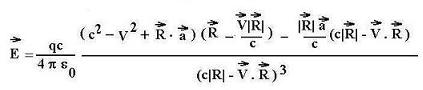
E - ∇ φ - ∂A/∂t = -qc/4πε0)/(c|R| - V . (R))3[(-R)( c2 + (R) . a -
V2 ) + V(c|R| - V . (R))]
- [(qc/4πε0/(c|R| - (R) .V)3][ ((a|R|/c) - V)(c|R| - (R) . V) + (V|R|/c)(c2 - V2 +(R).a)]
= - qc/4πε0)/(c|R| - V . (R))3[(-R + (V|R|/c))(c2 + (R) . a - V2) + (c|R| -
V . (R))((a|R|/c) - V + V)]
E = -qc/4πε0)/(c|R| - V . (R))3[(-R + (V|R|/c))(c2 +
(R) . a - V2) + (a|R|/c)(c|R| - V . R)]
More clearly,
Let's do the following notation change:

The expression of ∇ φ becomes:
∇ φ = (qc/4πε0)/(R . W)3[(-R)( c2 + (R) . a -
V2 ) + V(R . W]
and E becomes:
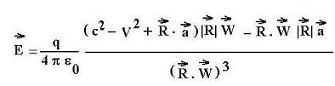
E = -qc/4πε0)/(R . W)3[(|R|W/c))(c2 + (R) . a - V2) + (a|R|/c)(R . W)]
= q|R|/4πε0)/(R . W)3[(c2 + (R) . a - V2)W - (R . W) a]
= q|R|/4πε0)/(R . W)3[(c2 - V2)W + (R . a) W - (R . W) a]
The last term is a cross product: (R . a) W - (R . W) a = R x (W x a), then:
E = = q|R|/4πε0)/(R . W)3[(c2 - V2)W +
R x (W x a)]
More clearly,
III. The expression of B
A = (V/c2)φ
B = ∇ x A = ∇ x ((V/c2)φ) = (1/c2) ∇ x ((V φ)
We know that : ∇ x ((V φ) = φ ∇ x V - V x ∇ φ
∇ φ is already expressed:
∇ φ = (qc/4πε0)/(c|R| - V . (R))3[(-R)( c2 + (R) . a - V2 ) + V(c|R| -
V . (R))]
= (qc/4πε0)/(R . W)3[(-R)(c2 + (R) . a - V2) + V(R . W)]
∇ x V = δi x V =
δ/δxi x V = δt'/δi δ/ δt' x V
We know that:
∂t'/ ∂xi = - (R)/(c|R| - (R) . V ) = - R/ R . W
Then:
∇ x V = (- R/ R . W) (δ/ δt' x V ) = - R x a / R . W
Rearranging, we get:
B = (1/c2)[ (φ(- R x a/ R . W) + V x ∇ φ]
Since φ = (qc/4πε0)/ R . W; It follows:
B = (1/c2)[ (φ(- R x a/ R . W) - V x (qc/4πε0)/(R . W)3)[(-R)( c2 +
(R) . a - V2 ) + V(R . W)]
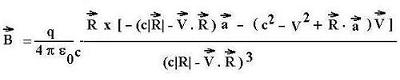
B = (q/c4πε0)/(R . W)3[[ - (R . W) R x a - V x (R) a - V x (c2 -V2)] -
V x V(R . W)]
But V x V = 0, it remains:
B = (q/c4πε0)/(R . W)3[- (R . W) (R x a) - (c2 -V2 + R.a) R X V ]
B = [(q/c4πε0) /(R . W)3] R X [ - (R . W ) a - (c2 -
V2) V - (R . a) V]
More clearly,

Physics/Moving-Charge/N
Or:
IV. Relationship between E and B
(1/c) ( ^R x E) =  q|R|/c4πε0)/(R . W)3[(c2 -  V2) ^R x W +
(R . a) ^R x  W - (R . W) ^R x  a]
Since W = ^R c - V; ^R x W = - ^R x V; then:
 ^R x E =  q|R|/4πε0)/(R . W)3[- (c2 -  V2)^R x V  - (R . a)^R x V  - (R . W) ^R x  a]
(1/c) ( ^R x E) =[q|R|/c4πε0)/(R . W)3]^R x [- (c2 -  V2)V  - (R . a)V  - (R . W) a]
= [q|R|^R /c4πε0)/(R . W)3]x [- (c2 -  V2)V  - (R . a)V  - (R . W) a]
= [q /c4πε0)/(R . W)3] R x [- (c2 -  V2)V  - (R . a)V  - (R . W) a]
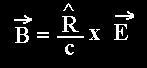
= B
Forethermore; B = ( ^R/c) x E
|
|