GAUSS'S LAW
1. Preliminary
We have already seen that the flux
Φ of the vector E through any closed surface is the integral of
the elementary flux dΦ over this closed surface:
dΦ = E dS cos θ
And
Φ = ∮∮ E . dS = ∮∮ E dS cos θ
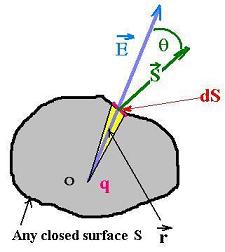
Let's write:
dΦ = E r2 dS cos θ/r2
But
dS (cosθ)/r2 = dΩ , the elementary solid angle.
Hence:
dΦ = E r2 dΩ
E is the electric field given by the Coulomb law:
E = q/4πε0 . 1/r2
It follows then:
dΦ = E r2 dΩ = q/4πε0 . dΩ
Hence:
Φ = ∫ q/4πε0 . dΩ = q/4πε0 . 4π = q/ε0 .
That is Gauss' Law.
∮∮ E . dS = q/ε0
2. Remarks
- If the closed surface is a cercle of radius R , we can write directly:
∮∮ E . dS =
(q/4πε0R2) ∮∮dS (q/4πε0R2) 4πR2 =
q/ε0

That means the flux of an electric field due to a charge in
a centre through any surface is not dependent of r nor of
the surface, but it's dependent of the charge inside the
surface.
- The expression of the flux
do depend only of q; then from the principle of
superposition, we can write for any number of charges
contained within the surface S:
Φ = ∮∮ E . dS = (1/ε0) Σ qi
3. Divergence of the vector field E
We know that from the Green Function
 thathe relationship (4), with k = 0, can be written:
 Δ G0(r - r') = δ(r - r')
And
- The relationship (19) can be written:
G0(r - r')= (-1/4π) /|r - r'|
We know also from:  The Gradient operator forrmula that:
 - ∇  (1/|r - r'|) = (r - r') / |r - r'|)3
It follows then:
∇ ((r - r') / |r - r'|3)) =
- ∇  ∇  (1/|r - r'|) = δ(1/|r - r'|)
= 4πδG0(r - r') = 4π δ(r - r')
 ∇ ((r - r') / |r - r'|3))  = 4π δ(r - r')
Hence:
From the Coulomb's formula, we have:
∇  . E = (1/4πε0) ∫ ρ (r') ∇ ((r - r') / |r - r'|3)) ;
Then:
∇  . E = (1/4πε0) ∫ ρ (r') .  4π δ(r - r') = (1/ε0) ρ (r)
Thus:
 ∇  . E = ρ (r)/ ε0
4. The potential Φ of the electric field E
From the Coulomb's expression of E and the Gradient operator forrmula,
we can write:
E = ∫ (1/4πε0) ρ(r') (- ∇  (1/|r -r'|)) d3r'
= - ∇    ∫ (1/4πε0) ρ(r') ( (1/|r -r'|)) d3r'
E = - ∇  (Φ), with:
Φ = (1/4πε0)  ∫ ρ(r')d3r'/|r -r'|

|