Mathematics
Physics
© The scientific sentence. 2010
|
GAUSS'S LAW FOR A MAGNETIC FIELD

ΦB = ∮ B . dS = 0
| |
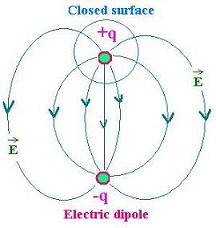
ΦE = ∮ E . dS = q/ε0
|
The figure above at right represents a couple of charges:
+q and - q that constitutes an electric dipole.
The lignes of the electric field E begin on  +q and end - q.

The figure above at left represents a bar magnet with the two
poles: The positive pole P and the negative pole N.
The lignes of the magnetic field go from N, pass through N and
come back to the start point. That is each line closes on itself.

Each magnetic line that pierces into a closed surface at a point,
pierces out of this closed surface at some other point. The net number
of lines crossing the closed surface is zero.

In other words: For any closed surface, the magnetic flux is null.

We can not isolate the pole N from the pole P as we can do
for +q and -q to have the same distribution of lines and thus
the net flux different from zero.  That is, we do not have a magnetic
charge as we have for electrostatic. There is no magnetic monopole!.


∮ B . dS = 0
|
|