Mathematics
Physics
© The scientific sentence. 2010
|
RETARDED POTENTIALS
I. In Statics
We have seen that  the potentials
in statics are as follows:
E = - ∇  φ,			(I.1)
with:
Φ = (1/4πε0)  ∫ ρ(r')d3r'/|r -r'|		(I.2)
B = ∇  x A 		(I.3)
Coulomb gauge:   ∇  . A = 0 		(I.4)
A(r) =  μ0/4π∫ J(r') /|r-r'| d3(r')		(I.5)
II. In Dynamics
II.1. Retarded forms
First, let's see the following figure:
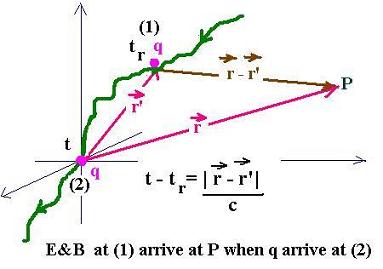
It is obvious that the potentials at the test
point (1) are not evaluated at the time tr;
It takes the time (|r - r'|/c) for the potentials to be
propagated till the measure point P; exactly when the
charge q is at (2) at the time t.
In other words, at the point (2), position (r), time t, we measure
the potentials at the point (1), position ( r - r'), time tr.
t - tr = |r - r'|/c (II.1)
The time tr = t - |r - r'|/c is called the retarded time and
the related potentials the retarded potentials.
The relasionships (I.2) and (I.5) become:
Φ(r) = (1/4πε0) ∫ d3r' ρ(r', tr)/|r - r'| (II.2)
A(r) = μ0/4π∫ d3r' J(r', tr) /|r-r'| (II.5)
II.2. Those expressions obey the Maxwell equations
We will state that if those solutions obey the Maxwell
equations, then they are their solutions.
Let's go from the expressions derived from the
Lorentz gauge; they are:
☐2 A = - μ0J		(II.6)
☐2 φ = - ρ/ε0		(II.7)
With ☐2 = ∇ 2 A - (1/c2)d2/dt2	(II.8)

Let's take the gardient of φ(r) from the expression (II.2)
∇  φ (r) = ∇ (1/4πε0)  ∫ d3r' ρ(r', tr)/|r - r'|)
We know that ∇ (ab) = a∇ (b) + b∇ (a)	(II.9)
Then:
∇  φ (r) = (1/4πε0)  ∫ d3r' ( (1/|r - r'|) ∇  ρ(r', tr) +
ρ(r', tr) ∇ (1/|r - r'|))	(II.10)
Let
u = r - r'
|u| = | r - r'|
û = The unit vector of u
û . û = 1
We have from (II.1) t - tr = |r - r'|/c, then
∇  ρ(r', tr) = (∂/∂tr . ∂tr/∂x , ∂/∂tr . ∂tr/∂y , ∂/∂tr . ∂tr/∂z)ρ(r', tr) =
(∂/∂x , ∂/∂y , ∂/∂z)∂/∂tr ρ(r', tr) = ∂(ρ(r', tr))/∂tr ∇ (tr)
∇  ρ(r', tr) = ∂(ρ(r', tr)/∂tr ∇ (t - |r - r'|/c) 		(II.11)
∇ (t - |r - r'|/c)		(II.12)
∇  operate on r not on r'. It follows:
∇ (t - |r - r'|/c) =  - ∇ ( |r - r'|/c) =  ( -1/c) ∇ |u|
We know that  ∇ |u| = û, then:
∇ (t - |r - r'|/c) = ( -1/c)û		(II.13)

Let :
ρ = ρ(r', tr)
∂ρ(r', tr)/∂tr = ρ'
∂ρ'(r', tr)/∂tr = ρ"

(II.11) is then:
∇  ρ = ( -1/c) ρ' û		(II.14)
We know that  ∇ (1/|u|) = - û/|u|2, then:
The relationship (II.10) becomes then:
∇  φ (r) = (1/4πε0)  ∫ d3r' ( ( -1/c)(1/|u|) ρ' û - ρ(r', tr) û/|u|2)		(II.15)

∇  φ (r) = (- 1/4πε0)  ∫ d3r' ( (ρ'/c) (û/|u|) +
ρ û/|u|2)   (II.16)

Let's take the divergence of  φ (r) :
Δ φ (r) = ∇  ∇  φ (r) = (- 1/4πε0)  ∫ d3r' ( ∇ (ρ'/c) (û/|u|) + ∇ ρ û/|u|2)   (II.17)
∇ (ρ'/c) (û/|u|) = (û/|u|)∇ (ρ'/c) + (ρ'/c) ∇ (û/|u|)		(II.18)
As in (II.11) and (II.14),
∇  ρ') = ∂(ρ/∂tr = ( -1/c) ρ" û
We have seen  ∇  . (û/|u|) = 1/|u|2
∇ (ρ'/c) (û/|u|) = (û/|u|)( -1/c2) ρ" û + (ρ'/c)(1/|u|2) =
( -1/c2) ρ"/|u| + ρ'/c|u|2)		(II.19)
We have seen  ∇  . (û /|u|2) = 4π δ3(u)		(II.20)
and from (II.14) ∇  ρ = ( -1/c) ρ' û		(II.21)
Then:
∇ ρ û/|u|2 = ρ ∇ û/|u|2 + û/|u|2∇ ρ = ρ(r', tr) . 4π δ3(u) +
û/|u|2 .( -1/c) ρ' û =
4π ρ δ3(u)  - (1/c)/|u|2  ρ'	(II.22)
Hence:
Δ φ (r) = (- 1/4πε0)  ∫ d3r'(( -1/c2) ρ"/|u| + ρ'/c|u|2) +
4π ρ(r', tr) δ3(u)  - (1/c)/|u|2  ρ') (II.23)
= (- 1/4πε0)  ∫ d3r'((  -1/c2) ρ"/|u| + 4π ρ δ3(u)
Δ φ (r) = (1/4πε0)  ∫ d3r'(ρ"/|u|c2 - 4π ρ δ3(u)   (II.24)
With r, r':

Δ φ (r) = (1/4πε0)  ∫ d3r'(ρ"(r', tr)/|u|c2 - 4π ρ(r', tr) δ3(r -r')   (II.25)
ρ"(r', tr) = ∂2/∂tr2 ρ(r', tr)
∫ d3r' ρ(r', tr) δ3( r- r') = ρ(r, tr)
The relationship (II.25) becomes:
Δ φ (r) = (1/4πε0)  ∫ d3r'1/|u|c2 ∂2/∂tr 2ρ(r', tr) - 4π ρ(r, tr)   (II.26)
1/c2 ∂2/∂tr2 (1/4πε0) ∫ d3r'ρ(r', tr)/| r -r'| =
1/c2 ∂r2/∂tr2 φ(r,t)		(II.27)
(1/4πε0)∫ d3r' ρ(r', tr) δ3( r- r')   = ρ(r, tr)/ε0  		(II.28)
Finaly:
∇ 2 φ(r) - 1/c2 ∂2/∂tr2 φ(r, tr)  = - ρ(r, tr)/ε0   (II.29)
That's exactly the equation of type (II.7); that is:
☐2 φ = - ρ/ε0
|
|