The following figure gives the expressions of the electric and magnetic fields in the terms of retarded potentials(Liénard-Wichert potentials) for a charged and accelerated particle.
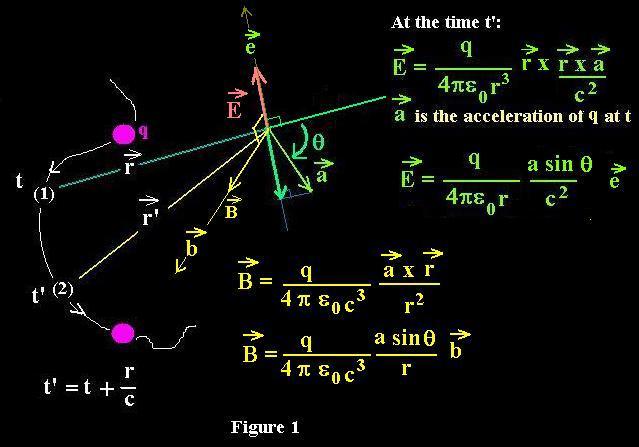
We have: B = E/c The pointing vector is S = E x B/ μ0 ( Power/area) Recall: ε0μ0c2 = 1. E is perpendicular to B, Then S = E B / μ0 = E2/cμ0 = cε0E2 Using the expression of E:
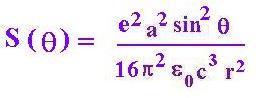
We have dP= /dA = S(θ) ( P the power is the ratio of energy on time = magnitude of the Poynting power times area) Then : P = ∫ S(θ) dA Where dA = r2dr = 2π r2 sin θ dθ P = 2π ∫ S(θ) r2 sin θ dθ (from 0 to 2π) = 2π(e2a2/16π2ε0c3) ∫ sin3 θ dθ ∫ sin3 θ dθ = ∫ sin2θ(- dcosθ) dθ = ∫ (cos2θ - 1)dcosθ = (1/3)(cos3θ - cosθ) (from 0 t0 π) = 4/3 Finaly, the Larmor's relationship takes the following expression:

That is the power emitted by a charged particle (electron) accelerated at a, via the electromagnetic wave (E,B).
