Particular cases of a moving charge
|
I. First case: Constant velocity. V and r are perpendicular
|
In the following figure:
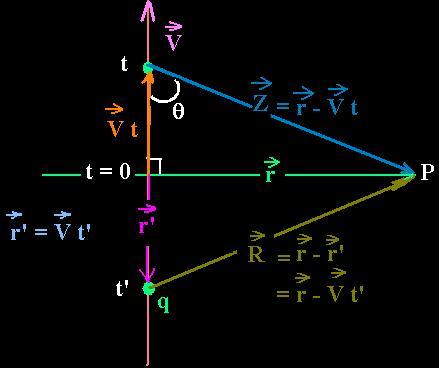
the origin of the time is set when after the retarded time t'.
We will express E and B at the time t. Th epoint od observation P
is set a plane perpendicular to the vector
velocity V.
R = r - r' = r - Vt'
Z = r - Vt
I. 1. Preliminaries
Let:
W = c^R -V
|R| W = |R| (c^R - V) = cR -|R|V = c( r - r') - Vc( t - t') = c( r - Vt') - Vc( t - t')
= cr - cVt' - Vct + Vct'= c(r -Vt)
^R = R/|R| = ( r - Vt')/|R| = (r - Vt) + (Vt - Vt')/|R| = ( Z + V|R|/c)/|R|
R . W = R . (c^R - V) = c|R| - R . V = c2 ( t - t') - ( r - Vt')V
= c2t - c2t' - r.V  + V2T' = c2t - (c2 - V2)t'

The equation |R|2 = |R|2 can be written as:
( r - Vt')2 = [C(t - t')]2
r2 - 2 . 0 + V2t'2 = c2( t2 - 2tt' + t'2)
Solving for t', we get:
(c2 - V2)t'2 - 2c2tt' + c2t2 - r2 = 0
Δ' = (c2t)2 -  c2 - V2][c2t2 - r2]
= (c2 - V2)r2 + c2V2t2
From the two available solutions t'(+,-); we take the negative one. Then:
t' = [c2t - (Δ')1/2]/[c2 - V2]
It follows that:
R . W = c2t - (c2 - V2)t'= cZ
= c2t - [c2 - V2][c2t - (Δ')1/2]/[c2 - V2]
= c2t - [c2t - (Δ')1/2] =   (Δ')1/2
= [c2(r2 + V2t2)  - V2r2]1/2
= c [r2 + V2t2]2 [ 1 - (V2r2/c2(r2 + V2t2))]1/2
From the above figure, we can see:
r2/( r2 +(Vt)2) = (r/Z)2 = sin2θ
Finaly,
R . W = c|Z|[ 1 - (V2/c2)sin2θ]1/2
I. 2. Expressions of E and B
From  the expressions of the potentials
We have :
 Φ(r,t) = (q/4πε0) / |r - r'|  - (V/c) . (r - r')
Φ(r,t) = (qc/4πε0) / c|R|  - (V/c) . R
= (qc/4πε0) / c|R|  - (V/c) . R
R = r - r'
and R . W = c|R| - R . V = c|Z|[ 1 - (V2/c2)sin2θ]1/2
Then:
Φ(r,t) = (qc/4πε0) / R . W = (q/4πε0) / |Z|[ 1 - (V2/c2)sin2θ]1/2

 Φ(r,t) = (q/4πε0) / |Z|[ 1 - (V2/c2)sin2θ]1/2
A = (V/c2) φ = (μ0/4π)qV)/ |Z|[ 1 - (V2/c2)sin2θ]1/2
A = (μ0/4π)qV)/ |Z|[ 1 - (V2/c2)sin2θ]1/2

The expression of E is:
E = q|R|/4πε0)/(R . W)3[(c2 -  V2)W + R x (W x a)]
E = q|R|/4πε0)/(R . W)3[(c2 -  V2)W + R x (W x a)]
= q|R|/4πε0)/(c|Z|[ 1 - (V2/c2)sin2θ]1/2)3[(c2 -  V2)W + R x (W x a)]
a = 0 , then:
E = (q|R|W/4πε0)/(R . W)3[(c2 -  V2)]
= q|R|W/4πε0)/(c|Z|[ 1 - (V2/c2)sin2θ]1/2)3[(c2 -  V2))]
E= (q/4πε0) cZ (c2 -  V2)/(c|Z|[ 1 -(V2/c2sin2θ]1/2)3
E= (q/4πε0) (^Z/Z2) ( 1 -  V2/c2)[ 1 - (V2/c2)sin2θ] - 3/2

The expression of B is:
B =  [(q/c4πε0) /(R . W)3]  [(c2 + V2) V ](- R x V)
=  [(q/c4πε0) /(R . W)3]  [c2 + V2](V x R)
Or
B = (^R/c) x E
Since : ^R = R/|R| = ( Z + V|R|/c)/|R| = Z/|R| + V/c; then:
B =  [Z/c|R| + V/c2] x E = [Z/c|R| + V/c2] x (^Z/Z2)
(q/4πε0) ( 1 -  V2/c2)[ 1 - (V2/c2)sin2θ] - 3/2
We have :^Z x z = 0;
It follows that:
B =  [Z/c|R| + V/c2] x E = [V x ^Z/ c2 Z2) (q/4πε0)
( 1 -  V2/c2)[ 1 - (V2/c2) sin2θ] - 3/2
Since : c2μ0ε0 = 1; then:
B = (qμ0/4π) (V x ^Z/ Z2)
( 1 -  V2/c2)[ 1 - (V2/c2)sin2θ] - 3/2
|
II. Second case: null velocity at the time t = 0
|
We have in this case:
w = c^R - V = c^R
RW = Rc^R = c|R|
|R|W = |R|c^R = cR
E = q|R|/4πε0)/(R . W)3[(c2 -  V2)W + R x (W x a)]
= q|R|/4πε0)/(c|R|)3[(c2)W + R x (W x a)]
= q|R|/4πε0)/(c|R|)3[(c2)W] + (q|R|/4πε0)/(c|R|3[ R x (c^R x a)]
= (q/4π)/(|R|)3[|R|^R] + (q/4πε0c2)/(|R|)3[R x (R x a)]
= (q/4π) R /|R|3 + (q/4πε0c2)(R x (R x a))/|R|3
The first term is the Coulomb contribution, the second is the radiation term.
EC = (q/4π) R /|R|3
ER = (q/4πε0c2)(R x (R x a))/|R|3


B = ( ^R/c) x E = ( ^R/c) x EC  + ( ^R/c) x ER
( ^R/c) x EC = ^R x R (q/4π)  /c|R|3 = ^R x ^R (q/4π)  /c|R|2 = 0
( ^R/c) x ER  = (q/4πε0c3) ( ^R) x (R x (R x a))/|R|3
= (qμ0/4πc) ( ^R) x (^R x (^R x a))/|R| = (qμ0/4πc) (- (^R x a))/|R|
= (qμ0/4πc) ( a x ^R)/|R| =  (qμ0/4πc) ( a x R)/|R|2
B =  (qμ0/4πc) ( a x R)/|R|2
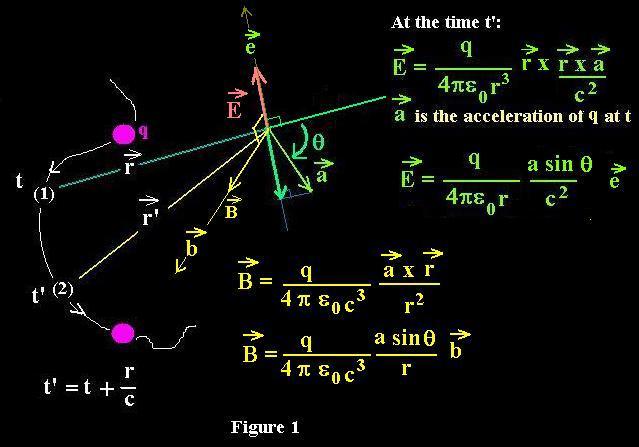
case of long distances: R = r - r' = r
EC = (q/4π) r /|r|3
ER = (q/4πε0c2)(r x (r x a))/|r|3

And
B =  (qμ0/4πc) ( a x r)/|r|2
As in the following figure:
S = (1/μ0) E x B = (1/μ0) E x [( ^R/c) x E] = (1/μ0c) E x [( ^R) x E]
Using the equation : A x ( B x C) = B ( A . C) - C ( A . B ), it follows:
S = (1/μ0c) [( ^R)(E . E) - E (E . ^R)] = (1/μ0c) [( ^R)(E2) - E (E . ^R)]
S = (1/μ0c) [( ^R)(E2) - E (E . ^R)]

E2 = [(q/4πε0c2)(^R x (^R x a))/|R|]2
But ^R x (^R x a) = ^R ( ^R . a)  - a ( ^R . ^R) = ^R ( ^R . a)  - a ; then:
E2 = [(q/4πε0c2)(^R ( ^R . a)  - a)/|R|]2
= [(q/4πε0c2)/|R|]2 [^R ( ^R . a)  - a]2
We have:
[^R ( ^R . a)  - a]2 = ( ^R . a)2 + a2 - 2( ^R . a)2 =  a2 - ( ^R . a)2
Then:
E2 = [(q/4πε0c2)/|R|]2 [a2 - ( ^R . a)2]

E (E . ^R) = [(q/4πε0c2)(^R ( ^R . a)  - a)/|R|]
[(q/4πε0c2)(^R ( ^R . a)  - a)/|R|]^R =
= [q/4πε0c2/|R|]2 [[(^R ( ^R . a)  - a)^R] [^R ( ^R . a)  - a]]
[[(^R ( ^R . a)  - a)^R] [^R ( ^R . a)  - a]] = [ ^R . a  - a. ^R][^R ( ^R . a)  - a] = 0; then:
E (E . ^R) = 0; and
S = (1/μ0c) [( ^R)(E2)] = (1/μ0c)(E2)^R
= (1/μ0c) [(q/4πε0c2)/|R|]2][( ^R)] [a2 - ( ^R . a)2]

If θ is the angle between r and a; the ^R .a = a cos θ and
a2 - ( ^R . a)2 = a2[ 1 - cos2 sin θ] = a2sin2 θ
Then:
S = (μ0/16 π2c) [(q a sin θ)/|R|]2 ^R
Total radiated power
P  = ∫ S . da
da = ^R d|a| = ^R |R|2 sin θ dθdφ
P = (μ0/16 π2c) [q a]2 ∫ sin3 θ dθdφ
∫ sin3 θ dθdφ = 2 π ∫ sin3 θ dθ= 2 π . (4/3)
For the value (4/3); see Larmor relationship
P = (μ0/6 πc) q2 a2
That is Larmor formula.
|